Mythology
warning NOTE: this is not meant to be a scholarly reference. None of the information here is meant to be accurate or true. This is part of a web design assignment and is not meant for any other use. Please do not link to or refer to this page.
The ancient Egyptians believed in many different gods and goddesses. Each one with their own role to play in maintaining peace and harmony across the land.
Some gods and goddesses took part in creation, some brought the flood every year, some offered protection, and some took care of people after they died. Others were either local gods who represented towns, or minor gods who represented plants or animals.
The ancient Egyptians believed that it was important to recognize and worship these gods and goddesses so that life continued smoothly.
Amun
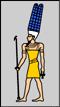 Appearance:
Man with a ram-head
A ram
Man wearing an ostrich plumed hat
Amun was one of the most powerful gods in ancient Egypt. At the height of Egyptian civilization he was called the 'King of the Gods'.
Amun was important throughout the history of ancient Egypt. However, when Amun was combined with the sun god Ra he was even more powerful. He was then called Amun-Ra.
A large and important temple was built at Thebes to honor Amun.
Anubis
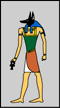 Appearance:
Man with a jackal head
A jackal
Anubis was the god of embalming and the dead.
Since jackals were often seen in cemeteries, the ancient Egyptians believed that Anubis watched over the dead.
Anubis was the god who helped to embalm Osiris after he was killed by Seth. Thus, Anubis was the god who watched over the process of mummifying people when they died.
Priests often wore a mask of Anubis during mummification ceremonies.
Aten
 Appearance:
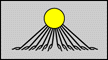
A sun disk with rays which end in hands
Aten was a form of the sun god Ra.
During the reign of Akhenaten, the Aten was made the 'king' of the gods.
Atum
'The All' or 'Perfection'
Appearance:
- Man with the double crown
Atum was a creator god.
The ancient Egyptians believed that Atum was the first god to exist on earth.

Atum
The ancient Egyptians believed that Atum rose from the waters of chaos (Nun) and created all the gods.
 Bastet
 Bastet
Appearance:
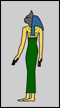
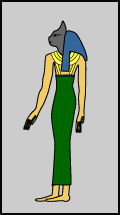
- Woman with the head of a cat
Bastet was a protective goddess.
Bastet
Bastet was usually seen as a gentle protective goddess. However, she sometimes appeared with the head of a lioness to protect the king in battle.
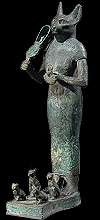
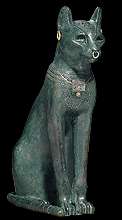 The
cat was a symbol of Bastet. The ancient Egyptians made many statues of cats like
this one to honor Bastet.
The
cat was a symbol of Bastet. The ancient Egyptians made many statues of cats like
this one to honor Bastet.
Bastet was one of the daughters of the sun god, Ra. A great temple was built in her honor at Bubastis in the Delta.
 Bes
Bes
 Bes
Bes
Appearance:
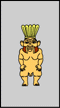
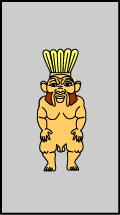
- Dwarf with lion and human features
- Dwarf wearing the skin of a lion
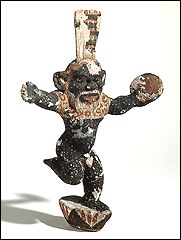
Bes was the protector of pregnant women, newborn babies and the family.
Bes
The ancient Egyptians also believed that Bes protected against snake and scorpion bites.
Amulets of Bes were popular at all levels of Egyptian society.
 Geb
Geb
Geb
Appearance:
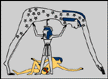
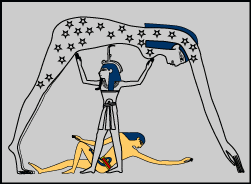
- Man lying down below the arch of the sky goddess Nut
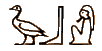
- Man with a goose on his head
Geb was the god of the earth.
Geb was the husband and brother of the sky goddess Nut. He was also the father of Osiris, Isis, Nepthys and Seth.
When Seth and Horus fought for the throne of Egypt, Geb made Horus the ruler of the living.
The ancient Egyptians believed that earthquakes were Geb's laughter.
 Hathor
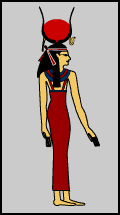
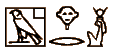 Hathor
'House of Horus'
Appearance:
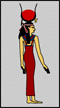
- Woman with the ears of a cow
- A cow
- Woman with a headdress of horns and a sun disk
Hathor was a protective goddess. She was also the goddess of love and joy.
Hathor was the wife of Horus, and was sometimes thought of as the mother of the pharaoh.
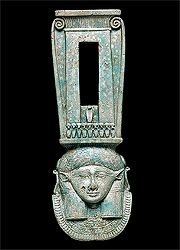
Hathor sistrum
A large temple was built to honor Hathor at Dendera.
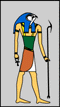 Horus
Horus
Horus
'The One Far Above'
Appearance:
- Man with the head of a hawk
- A hawk
Horus was a god of the sky.
He is probably most well-known as the protector of the ruler of Egypt.
The Egyptians believed that the pharaoh was the 'living Horus'.
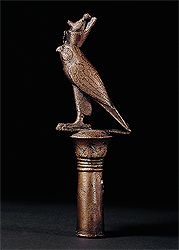
Horus standard
The ancient Egyptians had many different beliefs about the god Horus. One of the most common beliefs was that Horus was the son of Isis and Osiris.
After Osiris was murdered by his brother Seth, Horus fought with Seth for the throne of Egypt.
In this battle, Horus lost one of his eyes. The eye was restored to him and it became a symbol of protection for the ancient Egyptians. After this battle, Horus was chosen to be the ruler of the world of the living.
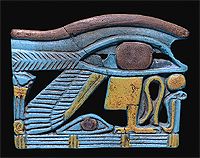
Eye of Horus
One of the best-preserved temples in Egypt today was dedicated to Horus. It is located in Upper Egypt at a town called Edfu.
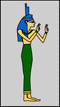 Isis
Isis
Isis
Appearance:
- Woman with headdress in the shape of a throne
- A pair of cow horns with a sun disk
Isis was a protective goddess. She used powerful magic spells to help people in need.
Isis was the wife of Osiris and the mother of Horus.
Since each pharaoh was considered the 'living Horus', Isis was very important.
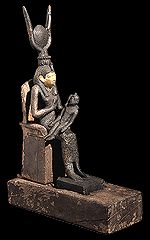
Isis with Horus
Isis is often shown holding Horus on her lap. Isis is associated with thrones because her lap was the first 'throne' that Horus sat upon.
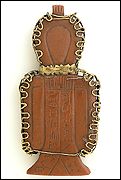 This
amulet
is called the 'Isis knot' and is a symbol of protection.
This
amulet
is called the 'Isis knot' and is a symbol of protection.
A temple was built to honor Isis at Philae.
It is still standing today.
 Ma'at
Ma'at
 Ma'at
Ma'at
Appearance:
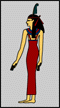
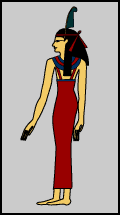
- Woman with a feather on her head
- A feather
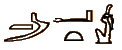
Ma'at was the goddess of truth, justice and harmony. She was associated with the balance of things on earth.
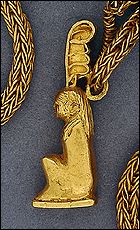
Ma'at pendant
Ma'at was the daughter of the sun god Ra.
Pharaohs are frequently shown in wall reliefs making an offering of Ma'at to the gods-showing that they are preserving harmony and justice on earth.
The vizier
who was in charge of the law courts was known as the 'priest of Ma'at'.
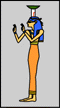 Nephthys
Nephthys
'Lady of the Mansion'
Appearance:
- Woman with headdress showing her name in hieroglyphs
Nephthys was a protective goddess of the dead.
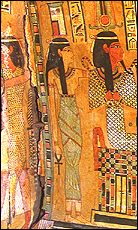
Nephthys
Nephthys was the sister of Isis and Osiris, and the sister/wife of Seth. Nephthys was also the mother of Anubis.
She is often shown on coffins, or in funerary scenes.
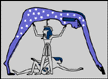 Nut
Nut
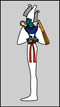 Osiris
Osiris
Appearance:
- A mummified man wearing a white cone-like headdress with feathers
Osiris was the god of the dead, and ruler of the underworld.
Osiris was the brother/husband of Isis, and the brother of Nepthys and Seth. He was also the father of Horus.
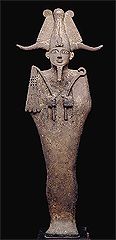
Osiris
As well as being a god of the dead, Osiris was a god of resurrection and fertility. In fact, the ancient Egyptians believed that Osiris gave them the gift of barley, one of their most important crops.
A large temple was built to honor Osiris at Abydos.
 Ra
Ra
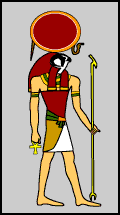
 Ra
Ra
'Sun'
Appearance:
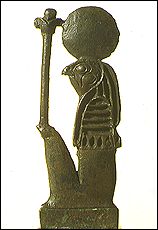
- Man with hawk head and headdress with a sun disk
Ra was the sun god. He was the most important god of the ancient Egyptians.
The ancient Egyptians believed that Ra was swallowed every night by the sky goddess Nut, and was reborn every morning.
Ra
The ancient Egyptians also believed that he traveled through the underworld
at night. In the underworld, Ra appeared as a man with the head of a ram.
 Sekhmet
Sekhmet
'The Powerful One'
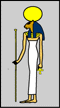
Appearance:
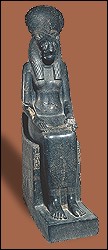
- Woman with the head of a lioness
Sekhmet was the goddess of war.
Statue of Sekhmet
 Seth
Seth
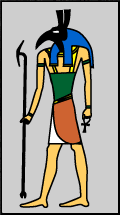
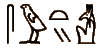 Seth
Seth
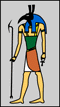
Appearance:
- Man with the head of a 'Seth animal' (unidentifiable)
Seth was the god of chaos.
Seth represented everything that threatened harmony in Egypt.
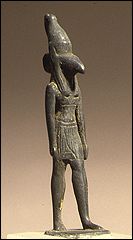
Statue of Seth
He was the brother of Osiris and Isis, as well as the brother/husband of Nepthys.
He murdered his brother Osiris, then battled with his nephew Horus to be the
ruler of the living.
At certain times in the history of ancient Egypt, Seth was associated with royalty.
 Thoth
Thoth
Thoth
Appearance:
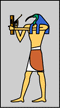
- A man with the head of an ibis holding a writing palette
- An ibis
- A baboon
Thoth was the god of writing and knowledge.
The ancient Egyptians believed that Thoth gave them the gift of hieroglyphic
writing. Thoth was also connected with the moon.
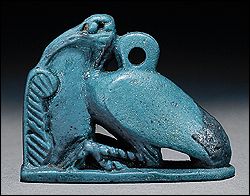
Thoth amulet