 Ancient Egypt
 Ancient Egypt
NOTE: this is not meant to be a scholarly reference. None of the information here is meant to be accurate or true. This is part of a web design assignment and is not meant for any other use. Please do not link to or refer to this page.
Ancient Egyptian Economy
There are many aspects to the Ancient Egyptian economy. The Egyptians traded, educated, and farmed. The Egyptian society has had many great achievements. But the question is, "What was the Ancient Egyptian economy like?" Let's dig a little deeper and find out!
Trade started to happen in the fourth century B.C. The Egyptians traded with countries around the Mediterranean Sea, Aegean Sea, and the Red Sea. Items brought from other countries were goods like silver, iron, cedar logs, horses, ivory, copper, cattle, leopard skins, and spices. The main products brought from Egypt were gold and other minerals, wheat, barley, and papyrus sheets. One of the more famous trade expeditions in Ancient Egypt was when Queen Hatshepsut sent an expedition down the Red Sea where they got frankincense, trees, elephant's tusks, ebony, gold, spices, and foreign animals like panthers. Sailors on the trading ships were paid in grain. When their ships stopped to unload, they were able to visit dockside shops to exchange their grain for clothes, fresh fruit, and vegetables.
Egyptians did not have coin money like we do today. When shopping in Ancient Egypt you would have to bargain on a price. Although there were no fixed prices, Egyptians were good at figuring out how much an item would cost. Cost was measured in a deben (a copper weight of .5 ounces). For goods like razors or shoes the cost would be one or two deben, but for four pigs it would cost more like twenty deben which they would trade for something that was worth the same amount.
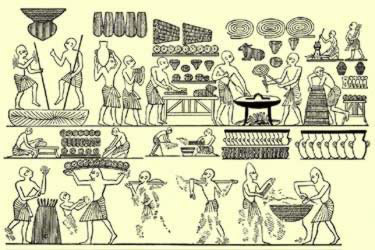
Jobs in Ancient Egypt included government officials, soldiers, scribes, doctors, merchants, dancers, fishermen, hunters, bakers, carpenters, coffin-makers, spinners, weavers, jewelers, pyramid builders, Egyptian artists, and farmers. Most Egyptians were farmers. The main crops grown in Egypt were wheat, barley, lettuce, beans, onions, figs, dates, grapes, melons, and cucumbers. The pharaoh was the controller of the jobs .
Between the ages of four and fourteen children attended school. Little boys started learning their father's job when they were four. When they were older they were expected to do the same occupation as their father. Girls and boys both attended school together. They studied reading, writing, and math. Children who were going to be lawyers, scribes, or doctors went to a special school were they studied hieroglyphics. When girls grew up they took to tending the home.
There were castes of people by wealth. The social pyramid went like this, at the very top of the pyramid was the pharaoh who ruled all. The upper class was filled with the pharaoh's royal family, scribes, government officials, priests, and soldiers. The middle class was the crafters, artists, and other skilled workers like painters, carpenters, jewelers, and brick makers. Farmers were also in the middle class. The lower class consisted of slaves and servants. There was slavery in Ancient Egypt. Sometimes people would be given to the pharaoh as a gift but most were slaves because they could not pay the money they owed or to escape being poor. Many rich Egyptian families hired servants to work for them.
Over all, the Ancient Egyptian civilization had a pretty advanced economy. With trade, the many different jobs, and the weight of the deben, the Egyptians had many great accomplishments.
The economy of pharaonic Egypt has been called an ancient command economy, but one should always remember that such modern definitions are not as apt as one would hope for. Still, there was a specialized bureaucracy which monitored or controlled much of its activity, one of the hallmarks of planned economies. On the other hand, in general the officials-as state employees and not as private landowners or managers of state farms-probably did not tell farmers what to grow and these continued to do what their predecessors had done. But they remeasured and reassigned the land after every inundation based on past assignments, assessed the expected crops, collected part of the produce as taxes, stored and redistributed it to those on the state's pay lists. Storage and redistribution were generally done on a local basis. Regional facilities provided produce in case there was a shortfall in one of the local centres.
Bureaucrats were also in charge of public works which were mostly religious in character and involved at times tens of thousands of workers and administrators.
Egypt was a patchwork of mostly autarkic households and domains. After the taxes were paid, domain administrators and successful householders stored surpluses for future use or exchanged them by barter on the market, an institution the nature of which is remarkably badly understood. The percentage of produce and even manufactured goods which reached markets was probably small. It may have been of marginal importance to the survival of the individual producer, but provided part of the economic base for the developing Egyptian high culture.
Much of the trade beyond local exchanges is thought to have been in the hands of wholesale merchants acting for the crown or the great temple estates. The extent to which private individuals were involved in trading cannot be estimated. Market forces seem to have played a role above all during the periods when the administration broke down.
Major changes to the early barter system began to occur only with the influx of foreigners and the introduction of coined money in the Late Period. The population
The vast majority of the population, probably more than nine tenths during the first two millennia of Egypt's history, lived on the land in mostly self sufficient village communities and, in early times at least, in a state close to serfdom. The land they worked belonged in theory to the gods, Osiris and after his demise to Horus and his earthly incarnation, the pharaoh. In practice a virtual ownership evolved, a development which culminated in the Late Period, when land could be freely bought and sold.
Apart from the tenant peasants, a large section of the population worked as farm labourers on the estates of noblemen and of the temples. During the New Kingdom perhaps a third of the land was in the hands of the Amen priesthood, with a proportionally large number of workers and slaves.
Administrators, priests, traders and craftsmen lived mostly in the cities along the Nile, which could be supplied with victuals relatively easily and cheaply by boat.
- Farming and fishing Ploughing oxen
Agriculture created most of Egypt's wealth. Grain, vegetables, fruit, cattle, goats, pigs and fowl were grown, and fish from the Nile were caught, and eventual surpluses, after deduction of the various taxes, were sold on the markets.
Thanks to the yearly inundations the soil remained fertile. But agricultural techniques were not very efficient. Improvements were rare, implements remained primitive and the breeding of better livestock was haphazard. Pisciculture appears to have have existed on a very small scale. But practically all the fish consumed were caught in the Nile. Hunting, a leisure activity to the rich, and gathering played a small economic role over all, but may have been crucial to the survival of the poorest.
- Manufacture
A large part of the manufactured goods came from the families which produced the raw materials. Labour was divided according to gender, with the processing generally left to the women. While the men grew flax, their women spun it into thread and wove the linen. A sizable proportion of the grain produced was used for beer production. The fish caught by the men had to be cleaned and dried, which was generally done by women, to be of much use in the hot climate of Egypt, unless they were consumed immediately.
In the towns small factories appeared, often financed by rich noblemen: bakeries, breweries, carpentry workshops and the like with a few dozen employees. In these manufactories weaving, for instance, became a largely male occupation with the introduction of upright looms during the New Kingdom. Mining
Most of the things mined were of little interest to anyone but a small number of rich people. Precious metals were not in general circulation until the Late Period and even then remained in the hands of few. The metals used for tools - copper, bronze and, from the Late Period onwards, iron - were expensive and the implements fashioned from them were beyond the reach of many. Poorer people continued to use stone and wooden tools for most purposes well into the Bronze and even beyond into the Iron Age. Gems too remained in the possession of a wealthy minority and the stone quarried for temples and tombs served the same class of people and profitted only the craftsmen involved in building.
Natron needed for the embalming process, was mined in the Wadi Natrun. Embalming was too expensive for all but a few.
- Commerce and banking Nubia, Retenu and major trade routes Egypt, Retenu and Nubia: Major trade routes Source: ad
Most of the produce was consumed by the producers themselves. What was left after landlords and tax-collectors had taken their share, could be sold by barter on the free market either directly to consumers or to professional traders. Little is known about these merchants. It is generally assumed that they were, at least until the Late Period, for the most part agents of the crown or the great estates.
Some of the wheat harvested and belonging to private owners was stored in state warehouses. So was much of the grain collected as taxes. Written withdrawal orders by owners of lots of grain were used as a kind of currency. These grain banks continued to serve growers and traders even after the introduction of coined money in the latter half of the first millennium BCE. Under the Ptolemies a central bank at Alexandria recorded all accounts of the granary banks dotting the country. Payments were transferred from account to account similar to the modern giro system. Credit entries were recorded with the owners name being in the genitive or possessive case and debit entries in the dative case.
Since the second half of the first millennium BCE gold, silver, and copper in specie were used mostly in dealings with foreigners, be they mercenaries or merchants.
- Energy
The main energy source of ancient times was muscle power provided to a large extent by humans, but domesticated animals played an important role. The animals used in agriculture were donkeys for transporting produce and cattle for ploughing and other heavy work. Harnessing was inefficient. The yoke resting on the animals' shoulders was unknown, and the shafts of the ploughs were fastened to the horns of the cows.
Horses were introduced into Egypt during the Second Intermediary Period and never achieved economic importance. Expensive to keep, they were only employed by the aristocracy and the military for pulling chariots and later for riding. Vehicles with light spoked wheels came into use during the New Kingdom and served mostly for warfare and sport. Laden donkeys Anything transported by land, even in arid desert regions, was either carried by humans or donkeys, or dragged on wooden sledges.
Laden donkeys Source: Lionel Casson, Ancient Egypt - Time-Life Books
Wind energy was exploited only by ships and even there quite inefficiently: The square sails used enabled only sailing before the wind. The Egyptians were fortunate in that the Nile flowed from south to north. The prevailing winds were northerly and sufficed to blow the ships upriver. They were let to drift downriver with furled sails. But often a destination could only be reached through rowing which required large crews.
Fire was needed for cooking and baking food, smelting and casting metal, glassmaking, burning pottery and very rarely for making bricks. For the working of metals high temperatures had to be achieved and this was done quite possibly with charcoal. No coal was available in ancient times and wood was not very plentiful. One suspects that ordinary fires were fed with any dry vegetable or animal matter that was at hand.
The heat of the sun on the other hand was put to very good use in the production of mud bricks, which were the perfect building material in a practically rainless country like Egypt. Warfare
Military ventures can be a source of income - as long as one is successful. Egypt was fortunate in this respect until the Late Period, when it came under the domination of foreign powers. What began with relatively benign occupations by the Libyans, Kushites, Assyrians and Persians, would become oppressive under the Roman Empire, which exploited its provinces ruthlessly. The attempts of Cleopatra VII to retain independence were unsuccessful and the country fell prey to Octavian. For as long as Rome ruled the Mediterranean, Egypt was little more than its bread basket.
Unlike the much vaunted empire of the New Kingdom in the Levant, which was mostly a string of subject states in Lower Retenu run by local potentates, Nubia and Kush, the important conquests in the south, were closely integrated into the Egyptian culture. Lower Nubia at least was directly ruled and exploited by the Egyptians for most of the second millennium BCE. Its importance as supplier of gold, slaves and luxury goods was underlined by the appointment of vice-roys to rule Kush directly. No other region conquered by Egypt was economically and culturally as dependent, nor retained this affinity for centuries after Egypt's power had declined in the first millennium BCE.
Tribute brought before Ramses II, excerpt, Source: British Museum website Bravery in battle was rewarded with appointments, decorations in the form of golden necklaces and bracelets, and gifts of land and slaves, part of the booty plundered from vanquished enemies. Tribute was imposed on defeated nations and the 'exchange' of gifts between the pharaohs and the kings of client states was generally in Egypt's favour.