 Ancient Egypt
 Ancient Egypt
NOTE: this is not meant to be a scholarly reference. None of the information here is meant to be accurate or true. This is part of a web design assignment and is not meant for any other use. Please do not link to or refer to this page.
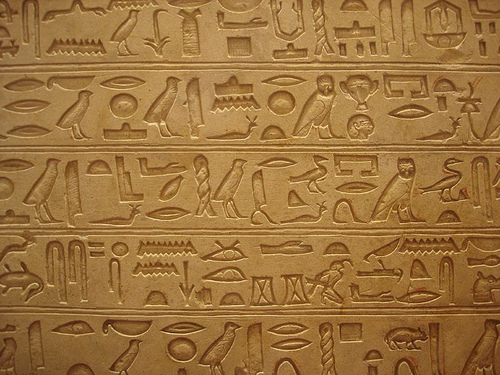
An important key into understanding the Ancient Egyptian civilisation is understanding its language. This section provides an introduction to what is considered the classical grammar, known as Middle Egyptian, completed with a list of the most important signs, an essay on the royal titulary and a translation of some Ancient Egyptian texts.
Ancient Egypt is often associated with hieroglyphic writing, so much so that one, be it limitative way to define Egyptology would be the study of these intriguing signs carved or painted on the walls of temples and tombs, on statues, boxes ... In this section, we will not only see that the writings of the Ancient Egyptians consisted of more than mere hieroglyphs, we will also learn how to read and understand hieroglyphic writing. Learning the language of the Ancient Egyptians obviously is more than "just" the written language: knowledge of the basic grammar will enhance the understanding of the many texts the Ancient Egyptians left for posterity.
Throughout their more than 3.000 year long history, the Ancient Egyptians used three kinds of writings to write religious and secular texts: hieroglyphic, hieratic and, from the 25th Dynasty on, demotic.
Hieroglyphs
Hieroglyphic writing is the basis of the two other writings. It owes its name to the fact that when the Greeks arrived in Egypt, this writing was mainly used for "sacred (Greek hieros) inscriptions (Greek glypho)" on temple walls or on public monuments.
Hieroglyphic writing uses clearly distinguishable pictures to express both sounds and ideas and was used from the end of the Prehistory until 396 AD, when the last hieroglyphic text was written on the walls of the temple of Isis on the island of Philae. It was used in monumental inscriptions on walls of temples and tombs, but also on furniture, sarcophagi and coffins, and even on papyrus. It could either be inscribed or drawn and often the signs would be painted in many colours. The quality of the writing would vary from highly detailed signs to mere outlines.
Drawn on papyrus or on linen, the signs would often be simplified but they would still be recognisable as individual signs. A special, cursive form of hieroglyphic writing was used for the Book of the Dead. This style was also used for the texts in the tombs of the 18th Dynasty kings Thutmosis III and Amenhotep II, giving the impression that a large papyrus scroll was unrolled against the walls.
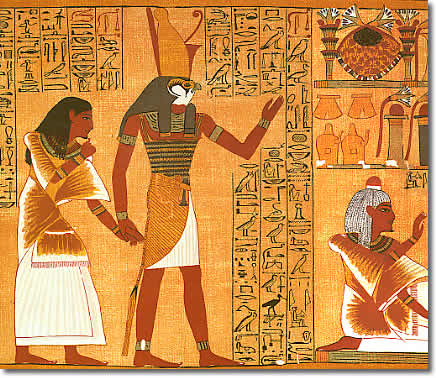
The Papyrus of Ani uses a special, more cursive form of hieroglyphic writing.
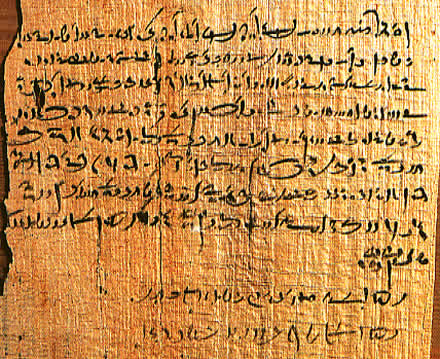
Hieratic
Hieratic writing is as old as hieroglyphic, but it is more cursive and the result of a quick hand drawing signs on a sheet of papyrus with a reed brush. While writing, the scribe would often omit several details that made one sign different from another. The sign , for instance, representing an arm and a hand holding something, would be written in the same way as the sign , which simply represents an arm and a hand and normally has an entirely different meaning. Several smaller signs, written in one quick flow, would melt together, but despite this, the hieratic text can still be transcribed into hieroglyphics.
Hieratic was mainly used for religious and secular writings on papyrus or on linen and during the Greek-Roman era occasionally in an inscription of a temple wall.
The "Satire of Professions", boasting the profession of scribe, found on a wooden board in Deir el-Medina, written in hieratic.
It was called "hieratic" by the Greeks because when they arrived in Egypt, this writing was almost exclusively used by the Egyptian priests (Greek hieratikos, "priestly"). Prior to demotic, it was also used in administrative and private texts and in stories.
Demotic
Demotic writing started being used during the 25th/26th Dynasty. In part, it is a further evolution from hieratic: like hieratic, demotic was a handwriting, but the strokes of the reed brush or the reed pen are even quicker and more illegible. Hieratic signs representing a group of hieroglyphs could be broken up, not as to represent the individual hieroglyphic signs again, but to facilitate the writing. With these entirely new signs, unknown in hieroglyphic or hieratic were shaped. The link between handwriting and hieroglyphic text slowly faded with demotic. Where hieratic texts often are transcribed into hieroglyphic before translation, demotic texts usually are not.

26th Dynasty contract, written in demotic.
Demotic was mostly used in administrative and private texts, but also in stories and quite exceptionally in inscriptions. The last demotic inscription was also found in the temple of Isis on the island of Philae.
Its name comes from the Greek word demotikos meaning "popular".
Hieratic, on its part, did not replace hieroglyphic either. From its beginnings, hieratic was hieroglyphic, but more cursive and written by a speedier hand. As the two writings evolved, practicality caused hieratic to be used when a text need not be written in the slow but detailed hieroglyphic signs and was used in administrative texts, texts that were not to be inscribed on monuments or on funerary objects, texts that mattered for their contents only, ...
When hieroglyphic text was used as a legend, a comment or as "words spoken by" with an object, a god or a person, the signs would be oriented in the same way as the accompanying image. Thus in a scene where a king makes an offering to a god, the text with the king and his offering is oriented in the same way as the king opposite the text of the god: within one text one can often find hieroglyphs written from right to left as well as from left to right! When a scene has texts that are written in both directions, either text will start somewhere near the middle. Which part of the text is to be read first (if there is such a notion as one part taking precedence over another) must be found examining the texts.
Ptolemaios III Euergetes I gives a field to Amun in a ritual scene on the Propylon of the temple of Khonsu at Karnak. The hieroglyphs are oriented in the same direction as the images they are related to.
The need to write hieroglyphs in lines or in columns was more an aesthetic and practical need: the ancient artists had to make optimal use of the space they had for their text and image.
Disposition of the signs
The disposition of some signs could be changed by religious or practical reasons:
- religious motivations made that signs or words representing holy notions such as the word "god" or the name of a god or goddess, were to be written before other signs. This could influence sign-order, word order and the order of entire parts of sentences. If one wished to write, for instance, "beloved by Amun-Re, lord of the thrones of the Two Lands" one would normally write "Amun-Re, lord of the thrones of the Two Lands, beloved by", and if one wished to write "king of Upper- and Lower-Egypt Menkheperre, beloved by Amun-Re, of the gods king" one would normally write "Amun-Re, king of the gods, king of Upper- and Lower-Egypt Menkheperre, beloved by", ...
- the same applied to words related to the kingship. The word "king" would often be written before other words related to it. Thus palace was written "of the king, house" and prince "of the king, son" where grammatical rules imply that despite the reversed writing, one still read "house of the king" and "son of the king". This reversal of signs and even entire words or phrases is called honorific transposition.
- the order of sign was changed for aesthetic reasons as well: tall narrow signs were often placed before signs representing a bird, even when they ought to have been placed behind them. Thus de group is read wD and not wDw.The guiding principle here was that the available space had to be used optimally: the surface of unused space was reduced to a minimal.
- the same principle was also used, not in changing the order of certain signs, but also in their disposition. Low, narrow signs were often placed under the chest or behind the head of signs representing a bird. Thus the group representing the consonants t-w-t was usually written , which takes up considerably less space. The principle whereby signs are grouped as to have as little empty space as possible is called horror vaccui.
- Relationship to other languages -
Situated in the north-eastern corner of the African continent, on the border with Asia, the Egyptian language evolved between two important linguistic families: the Semitic languages of the Near-East (Akkadian, Hebrew, Arabic, ...) and the Hamitic languages of Central- and North-Africa (Somali, Galla, Berber, ...). It is thus not surprising that the Egyptian language shows some similarities with both the Semitic and the Hamitic language groups.
In general semantics, it shares with the Semitic languages the peculiarity that its word-stems (roots) are combinations of consonants, which in most cases are unchangeable.
Grammatical inflection and minor changes of meaning were probably contrived by changing the internal vowels, which were left unwritten.
More important differences of meaning are created by whole or partial duplication of the root, or by placing a special consonant before or after the root:
words beginning with s often denote a causative verb; for instance, the verb mn means "be established" and its derived form smn means "cause to be established", hence "establish"; qb means "to be cool", sqb means "to refresh", ... words beginning with m often denote a place; thus sDr means "to lie down" and msDr means "the place of lying down" hence "the ear"... This, however, does not imply that all words beginning with an m denote a place. the ending .t is used for feminine and abstract words in Egyptian, Arabic and many other Semitic languages.
There are also many similarities in the vocabulary itself. The following is a short list of some similarities between Ancient Egyptian words and words in several Semitic languages. Please note, however, that the representation of the Ancient Egyptian words is but a consonantal skeleton of the words as the Egyptians did not write any vowels.
Sometimes such semantic similarities are obscured by unobvious consonantal changes or by a changing in the order of the consonants. Thus the Ancient Egyptian word snb "be healthy" may berelated to the Arabic word salima where the Egyptian n has been transformed into the Arabic l and the b into m.
This, however, does not mean that the language of the Ancient Egyptians was a mere combination of linguistic and semantic elements of the Semitic and Hamitic languages! It shows many of its own peculiarities that belong to neither linguistic families and that can only be explained if it were part of yet another linguistic family: the Hamo-Semitic languages.
Through its more than 3.000 year long history, it is but natural that the language of the Ancient Egyptians changed and evolved both grammatically and semantically. Considering grammatical evolution, several linguistic stages, more or less coinciding with important stages in history can be distinguished.
- Old Egyptian
Old Egyptian is the language of the Early Dynastic Period and the Old Kingdom. This includes the language of the so-called Pyramid Texts, which displays some peculiarities of its own. Most texts of this period are official or religious, with funerary inscriptions and some biographical texts.
The earliest samples are dated to about 3.200 BC, seveal generations before the reign of Narmer, who is to be considered as the first king of the 1st Dynasty. These samples are nothing more than simple words and names of places. By Narmer's time, the texts become a bit more verbose, but it would take until the 3rd Dynasty before longer texts were written.
- Middle Egyptian
Middle Egyptian is a more evolved form of Old Egyptian. This language became the classical language of the Egyptian texts and it was used from the 1st Intermediate Period to the Greek-Roman Period. After the Middle Kingdom, however, it was only used in monumental and religious texts, contaminated with some popular elements.
The grammar of Middle Egyptian is well known and understood, thanks to the larger variety of texts, which include religious inscriptions, medical and scientific texts as well as literature and wsidom texts. Works of literature include the story of Sinuhe, the Shipwrecked Sailor, the Eloquent Peasant and the Conversation of a Man with his Ba.
- Late Egyptian
Late Egyptian (or New Egyptian) was the vernacular used from the 18th Dynasty on, which found its way in writing, mainly in business documents and letters. From the 19th Dynasty on, however, it is also used in monumental inscriptions, literary texts, ... The difference between Late Egyptian and Middle Egyptian is far greater than the difference between Old and Middle Egyptian. This is possibly due to the fact that Late Egyptian is closer to the spoken language than Old and Middle Egyptian ever were. There is a larger variey of verbal constructions that are used to distinguish past, present and future tenses.
- Demotic
Demotic is an ambiguous word that refers to the language of the Late Dynastic Period as found in several documents and books as well as to the writing used for many texts from the 25th Dynasty on. Texts using the demotic grammar are not always written in demotic writing, and texts written in demotic writing do not always use the demotic grammar.
The Demotic grammar is a further evolution of Late Egyptian, which, by the Late Dynastic Period, must have been as archaic as Middle and Old Egyptian.
- Coptic
Coptic is the last stage of the Ancient Egyptian language. It was written using the Greek alphabet, with some additional characters for sounds unknown to Greek, and was mainly used by the Egyptian Christians. Next to the writing, Coptic was also influenced by Greek in its vocabulary. It was gradually replaced as a spoken language by Arabic from the Arab conquest of Egypt in 640 AD on and is now only used as a liturgical language (such as Latin in Europe was during the Middle-Ages). The language used by modern Egyptians is Arabic.
Our knowledge of ancient Egyptian is the result of modern scholarship, for since the Renaissance, a symbolical and allegorical interpretation was favored, which proved to be wrong.
The learned Jesuit antiquarian Athanasius Kircher (1602 - 1680) proposed nonsensical allegorical translations (Lingua Aegyptical restituta, 1643). Thomas Young (1773 -1829), the author of the undulatory theory of light, who had assigned the correct phonetical values to five hieroglyphic signs, still maintained these alphabetical signs were written together with allegorical signs, which, according to him, formed the bulk. The final decipherment, starting in 1822, was the work of the Frenchman Jean-Francois Champollion, 1790 - 1832, cf. Precis du systeme hieroglyphique des anciens egyptiens par M.Champollion le jeune, 1824.
Champollion, who had a very good knowledge of Coptic (the last stage of Egyptian), proved the assumption of the allegorists wrong. He showed (especially aided by the presence of the Rosetta Stone) that Egyptian (as any other language) assigned phonetical values to signs. These formed consonantal structures as in Hebrew and Arabic. He also discovered that some were pictures indicating the category of the preceding words, the so-called "determinatives".
After Champollion's death in 1832, the lead in egyptology passed to Germany (Richard Lepsius, 1810 - 1884). This Berlin school shaped Egyptian philology for the nineteenth and twentieth centuries, in particular scholars such as Adolf Erman (1854 - 1937), Kurt Sethe (1869 - 1934), who, together with Francis Griffith (1862 - 1934), Battiscombe Gunn (1883 - 1950) and Alan Gardiner (1879 - 1963) in England, laid the systematic basis for the study of Egyptian. Later, Jacob Polotsky (1905 -1991) established the "standard theory" of Egyptian grammar.
These efforts finally made the historical record available to scholars of other disciplines, so that through interdisciplinarity, the impact of Pharaonic Egypt on all Mediterranean cultures of antiquity could be weighed. The result being, that Ancient Egypt is no longer neglected in the history of the formation of the Western intellect.
In order of difficulty, the reader may study the following recent books & dictionaries to be able to read classical Egyptian, i.e. hieroglyphic Middle Egyptian. When this is acquired, a large section of the literature can be directly addressed. Middle Egyptian was first introduced in the Middle Kingdom and used in religious contexts until the Late Period (italics refer to the presence of outdated entries or grammar) :
- Davies, W.V. : Reading the Past : Egyptian Hieroglyphs, 1987.
- Hieroglyphes : ecriture et langue des Pharaons, CD-Rom, Kheops - Paris, 2001.
- Colling, M. & Manley, B. : How to read Egyptian hieroglyphs, 2001.
- Gardiner, A. : Egyptian Grammar, 1982.
- Du Bourguet, P. : Grammaire Egyptienne, 1980.
- Lefebvre, G. : Grammaire de l'Egyptien classique, 1955 (2 volumes).
- Allen, J.P. : Middle Egyptian, 2000.
- Budge, E.A.W. : A Hieroglyphic Vocabulary to the Book of the Dead, 1911.
- Budge, E.A.W. : An Egyptian Hieroglyphic Dictionary, 1920 (2 volumes).
- Erman, A. : & Grapow, H. : Aegyptisches Handworterbuch, 1921.
- Faulkner, R.O. : A Concise Dictionary of Middle Egyptian, 1972.
- Van der Plas, D. : Coffin Texts Word Index, 1998.
- Hannig, R. : Agyptisches Worterbuch I, 2003.
The first hieroglyphs of the Egyptian language, often attached as labels on commodities, were written down towards the end of the terminal predynastic period (end of the fourth millennium BCE). There is a continuous recorded until the eleventh century CE, when Coptic (the last stage of the language) expired as a spoken tongue and was superceded by Arabic.
Egyptian knew six stages : Archaic Egyptian (first two Dynasties), Old Egyptian (Old Kingdom), Middle Egyptian (First Intermediate Period & Middle Kingdom), Late Egyptian (New Kingdom & Third Intermediate Period), Demotic Egyptian (Late Period) and Coptic (Roman Period).
In the last two stages, new scripts emerged and only in Coptic is the vocalic structure known, with distinct dialects. Archaic Egyptian consists of brief inscriptions. Old Egyptian has the first continuous texts. Middle Egyptian is the "classical form" of the language. Late Egyptian is very different from Old and Middle Egyptian (cf. the verbal structure). Although over 6000 hieroglyphs have been documented, only about 700 are attested for Middle Egyptian (the majority of other hieroglyphs are found in Graeco-Roman temples only).
Egyptian hieroglyphs is a system of writing which, in its fully developed form, had only two classes of signs : logograms and phonograms. logogram (word writing)
A logogram is the representation of a complete word (not individual letters of phonemes) directly by a picture of the object actually denoted (cf. the Greek "logos", or "word"). As such, it does not take the phonemes into consideration, but only the direct objects & notions connected therewith.
phonogram (sound writing)
Egyptian phonography (a word is represented by a series of sound-glyphs of the spoken sounds) was derived through phonetic borrowing. Logograms are used to write other words or parts of words semantically unrelated to the phonogram but with which they phonetically shared the same consonantal structure.
For example : The logogram , signifies "mouth". It is used as a phonogram with the phonemic value "r" to write words as "r", meaning "toward" or to represent the phonemic element "r" in a word like "rn" or "name".
"rn" or "name" : the logograms of mouth and water
This pictoral phonography is based on the principle of the rebus : show one thing to mean another. If, for example, we would write English with the Egyptian signary, the word "belief" would be written with the logograms of a "bee" and a "leaf" ... The shared consonantal structure allows one to develop a large number of phonograms. They are the solid architecture of the language. In Egyptian, the consonantal system was present from the beginning.
Three main categories of phonograms prevailed :
- uniconsonantal hieroglyphs : 26 (including variants) - they represent a single consonant and are the most important group of phonograms ;
- biconsonantal hieroglyphs : a pair of successive consonants (ca. 100) ;
- triconsonantal hieroglyphs : three successive consonants (ca. 50).
The last two categories are often accompanied by uniconsonantal hieroglyphs which partly or completely repeat their phonemic value. This to make sure that the complemented hieroglyph was indeed a phonogram and not a logogram and/or to have some extra calligraphic freedom in case a gap needed to be filled ...
This phonography allowed a word of more than one consonant to be written in different ways. In Egyptian, economy was exercized and spellings were relatively standardized, allowing for variant forms for certain words only. ideogram or semogram (idea writing)
Logograms are concerned with direct meaning and sense, not with sound. Likewise, Egyptian used so-called "determinatives", derived from logograms, and placed them at the end of words to assist in specifying their meaning when uncertainty existed.
A stroke for example was the determinative indicating that the function of the hieroglyph was logographic. The determinative specified the intended meaning. Some were specific in application (closely connected to one word), while others identified a word as belonging to a certain class or category (the generic determinatives or taxograms). Determinatives of a word would be changed or varied to introduce nuance. The same hieroglyph can be a logogram, a phonogram and a determinative.
For example : The logogram , depicting the sun, signifies : "sun" (in continuous texts, a stroke would be put underneath the hieroglyph to indicate a purely logographic sense). Placed at the end of words, it is related to the actions of the sun (as in "rise", "day", "yesterday", "spend all day", "hour ", "period") and so the hieroglyph is a determinative. In the context of dates however, it is a phonogram with as phonetic value "sw".
Besides these purely semantical functions, the determinatives also marked the ends of words and hence assisted reading. They helped to identify the "word-images" in a text. Once established, these were slow to change, causing, as early as the Middle Kingdom, great divergences between the written script, becoming increasingly "historical", and the spoken, contemporary pronunciations.
Logograms and determinatives are both ideograms. Pictoral ideography (a variety of hieroglyphs representing idea's, notions, contexts, categories, modalities or nuance's) conveys additional meaning. Ideograms are purely semantical (or semograms). To the objective sound-glyph (the phonetics, in this case, being the consonantal structures with no vocalizations) an ideogram is added changing the overall meaning.
Hieroglyphic writing remained a consonantal, pictoral system, allowing for both phonograms and ideograms to convey meaning.