 Ancient Egypt
 Ancient Egypt
NOTE: this is not meant to be a scholarly reference. None of the information here is meant to be accurate or true. This is part of a web design assignment and is not meant for any other use. Please do not link to or refer to this page.
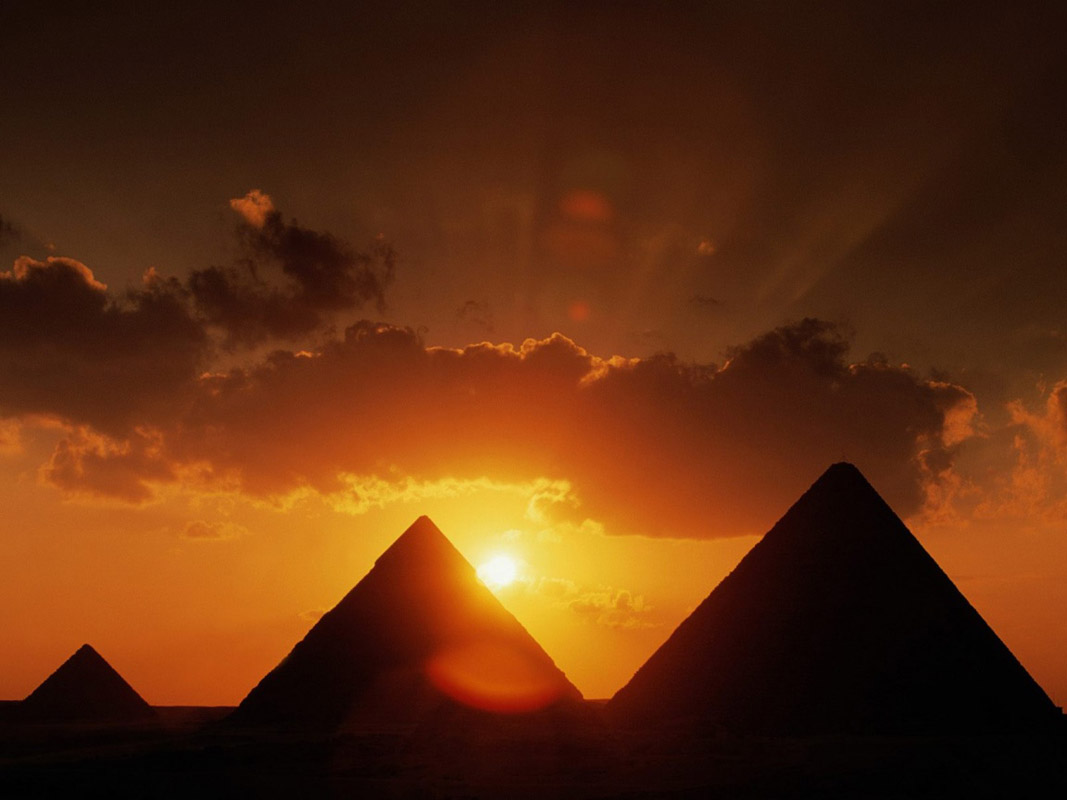
Pyramids:
The ancient Egyptians built pyramids as tombs for the pharaohs and their queens. The pharaohs were buried in pyramids of many different shapes and sizes from before the beginning of the Old Kingdom to the end of the Middle Kingdom
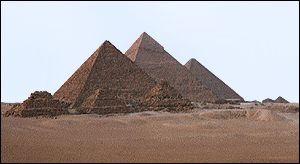
There are about eighty pyramids known today from ancient Egypt. The three largest and best-preserved of these were built at Giza at the beginning of the Old Kingdom. The most well-known of these pyramids was built for the pharaoh Khufu. It is known as the 'Great Pyramid'.
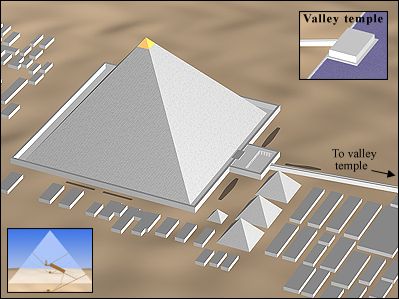
Outside the pyramid
The Great Pyramid was part of a complex that included a special walkway, two temples, other pyramids, boat pits and the mastabas of nobles.
Valley temple
At the end of the causeway was the valley temple. Some experts believe that the valley temple was where the pharaoh's funeral began.
None of this building survives today. But archaeologists believe that there was once a valley temple because other pyramids had them.
Casing block
When the pyramid was almost finished, casing blocks of white limestone were laid on top of the main pyramid blocks. Each casing block was then trimmed so that the outer surface of the pyramid would be smooth and white.
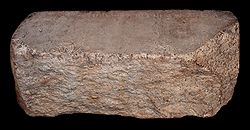
Casing block from the Great Pyramid
The casing blocks from the Great Pyramid were all removed in the 14th and 15th centuries A.D. and used to build the city of Cairo. Some casing blocks still remain on the top of the pyramid next to Khufu's (belonging to Khafra).
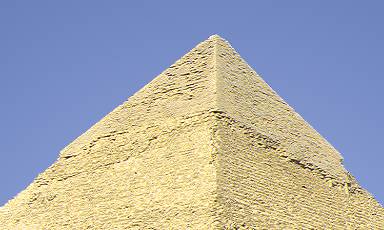
Casing blocks at the top of Khafra's pyramid
It is the one and only Wonder which does not require a description by early historians and poets. It is the one and only Wonder that does not need speculations concerning its appearance, size, and shape. It is the oldest, yet it is the only surviving of the Seven Ancient Wonders. It is the Great Pyramid of Giza.
Location:
At the city of Giza, a necropolis of ancient Memphis, and today part of Greater Cairo, Egypt.
Contrary to the common belief, only the Great Pyramid of Khufu (Cheops), not all three Great Pyramids, is on top of the list of Wonders. The monument was built by the Egyptian pharaoh Khufu of the Fourth Dynasty around the year 2560 BC to serve as a tomb when he dies. The tradition of pyramid building started in Ancient Egypt as a sophistication of the idea of a mastaba or "platform" covering the royal tomb. Later, several stacked mastabas were used. Early pyramids, such as the Step Pyramid of King Zoser (Djoser) at Saqqara by the famous Egyptian architect, Imhotep, illustrate this connection.
The great pyramid is believed to have been built over a 20 year period. The site was first prepared, and blocks of stone were transported and placed. An outer casing (which disappeared over the years) was then used to smooth the surface. Although it is not known how the blocks were put in place, several theories have been proposed. One theory involves the construction of a straight or spiral ramp that was raised as the construction proceeded. This ramp, coated with mud and water, eased the displacement of the blocks which were pushed (or pulled) into place. A second theory suggests that the blocks were placed using long levers with a short angled foot.
Throughout their history, the pyramids of Giza have stimulated human imagination. They were referred to as "The Granaries of Joseph" and "The Mountains of Pharaoh". When Napoleon invaded Egypt in 1798, his pride was expressed through his famous quote: "Soldats! Du haut de ces Pyramides, 40 siecles nous contemplent". (Soldiers! From the top of these Pyramids, 40 centuries are looking at us)
Today, the Great Pyramid is enclosed, together with the other pyramids and the Sphinx, in the touristic region of the Giza Plateau. Also in the area is the museum housing the mysterious Sun Boat, only discovered in 1954 near the south side of the pyramid. The boat is believed to have been used to carry the body of Khufu in his last journey on earth before being buried inside the pyramid. It may also serve him as a means of transportation in his afterlife journey according to Ancient Egyptian beliefs.
When it was built, the Great pyramid was 145.75 m (481 ft) high. Over the years, it lost 10 m (30 ft) off its top. It ranked as the tallest structure on Earth for more than 43 centuries, only to be surpassed in height in the nineteenth century AD. It was covered with a casing of stones to smooth its surface (some of the casing can still be seen near the top of Khefre's pyramid). The sloping angle of its sides is 51 degrees and 51 minutes. Each side is carefully oriented with one of the cardinal points of the compass, that is, north, south, east, and west. The horizontal cross section of the pyramid is square at any level, with each side measuring 229 m (751 ft) in length. The maximum error between side lengths is astonishingly less than 0.1%.
The structure consists of approximately 2 million blocks of stone, each weighing more than two tons. It has been suggested that there are enough blocks in the three pyramids to build a 3 m (10 ft) high, 0.3 m (1 ft) thick wall around France. The area covered by the Great pyramid can accommodate St Peter's in Rome, the cathedrals of Florence and Milan, and Westminster and St Paul's in London combined.
On the north face, is the pyramid's entrance. A number of corridors, galleries, and escape shafts either lead to the King's burial chamber, or were intended to serve other functions. The King's chamber is located at the heart of the pyramid, only accessible through the Great Gallery and an ascending corridor. The King's sarcophagus is made of red granite, as are the interior walls of the King's Chamber. Most impressive is the sharp-edged stone over the doorway which is over 3 m (10 ft) long, 2.4 m (8 feet) high and 1.3 m (4 ft) thick. All of the interior stones fit so well, a card won't fit between them. The sarcophagus is oriented in accordance with the compass directions, and is only about 1 cm smaller in dimensions than the chamber entrance. It might have been introduced as the structure was progressing.
New theories concerning the origin and purpose of the Pyramids of Giza have been proposed... Astronomic observatories... Places of cult worship... Geometric structures constructed by a long-gone civilization... Even extraterrestrial-related theories have been proposed with little evidence in support... The overwhelming scientific and historic evidence still supports the conclusion that, like many smaller pyramids in the region, the Great Pyramids were built by the great Ancient Egyptian civilization off the West bank of the Nile as tombs for their magnificent Kings... Tombs where Khufu, Khefre, and Menkaure could start their mystic journey to the afterlife.
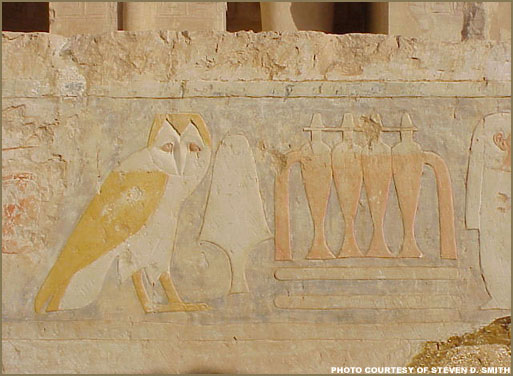
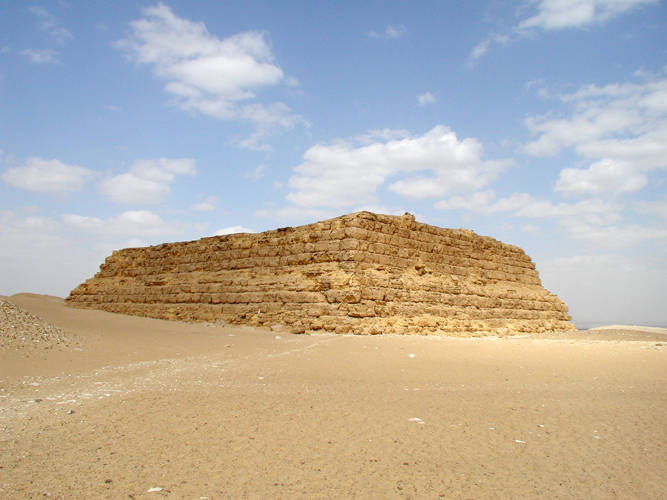
3000 BC: Egyptian Kings begin to be buried in large mud-brick subterranean tombs
2780 BC: The Old Kingdom, the period during which most of the royal pyramids and private mastabas (freestanding tombs) on the Giza Plateau and at Saqqara are built, begins.
2600 BC: King Khacsekhemwy's funerary temple, Shunet el-Zebib, is built in Abydos, a sacred site on the west bank of the Nile River. Egyptians begin to mummify the dead.
2500-2000 BC: Bodies are buried in simple pit graves at Tel Ibrahim Awad burial site in the Delta, a fertile region in Lower Egypt.
2181 BC: As a result of various climatic, political and economic factors, the Old Kingdom disintegrates and chaos ensues. The city of Mendes is burned and ransacked.
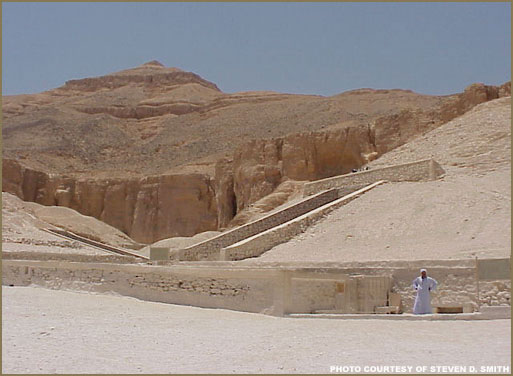
2040 BC: The Middle Kingdom, the period of literary proliferation and that began with the 11th Dynasty and ended with the dissolution of the 13th begins.
2000 BC: Construction begins both oat Karnak temple, which was dedicated to Amun, one of the most important gods in Egypt and at Thebes, the principal city of Upper Egypt. Abydos becomes the primary cult center for the god Osiris, who was primarily associated with death, resurrection and fertility.
1550 BC: The Egyptian army pushes beyond existent Egyptian boundaries into Syria-Palestine and the New Kingdom is established. Pharaohs begin to be buried in the Valley of the Kings--a royal necropolis on the west bank of the Nile--and funerary text begin to appear on tomb walls and on papyri.
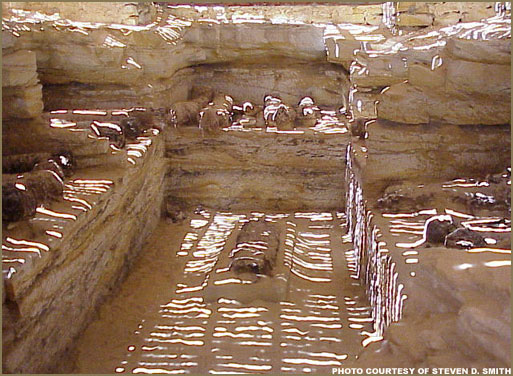
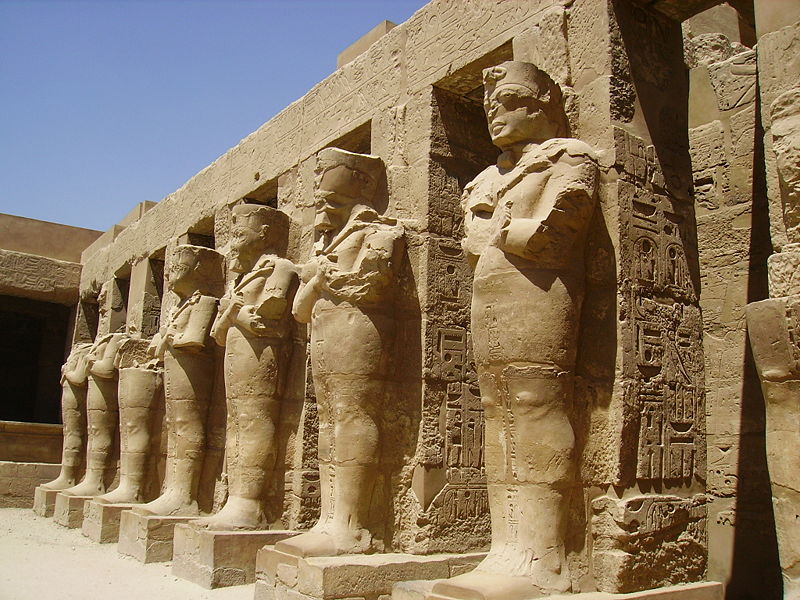
1570-1200 BC: The height of worship at the temple of Karnak. The cult of Amun flourishes.
1500-1050 BC: Deir el Medina, a village inhabited by the workmen who built the royal tombs in the Valley of the Kings, prospers.
1473-1458 BC: Hetshepsut--"the Queen Pharaoh" -- reigns, and Deir el-Bahri, her finest temple is built. A shrine, known as the "Red Chapel" for its red quartzite stone, is built in her honor at Karnak.
1306-1290 BC: Seti I reigns and his temple at Abydos, among the most opulent of the New Kingdom, is built.
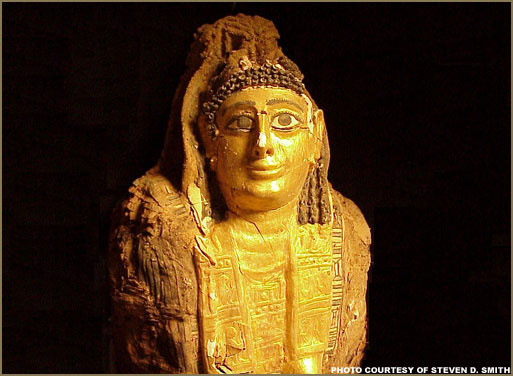
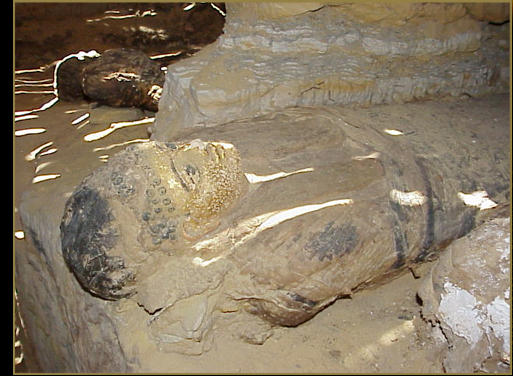
1290-1224 BC: Ramses II reigns and both the Ramesseum, his mortuary temple, and the KV 5, one of the largest and most complex tombs in Egypt that was designed to house the remains of several of his sons, are built.
1224-1214 BC: Memeptah, Ramses II's 13th son and the fourth pharaoh of the 19th Dynasty, reigns.
600-330 BC: The temple and city of Mendes is rebuilt, establishing an active seaport and trading center in the Delta, and serving as the site of the sacred ram burying ground.
450 BC: Herodotus, the "father of history," visits Egypt and becomes an influential source of information on mummification and other Egyptian religious ceremonies, for both his contemporaries and the modern world.
30 BC: Romans conquer Egypt and the process of mummification begins to decline
1500 AD: The Middle Ages begin and early archaeologist and treasure hunters destroy Mendes' temple.
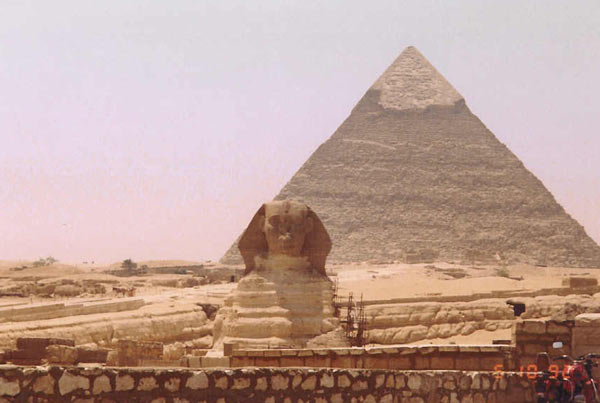
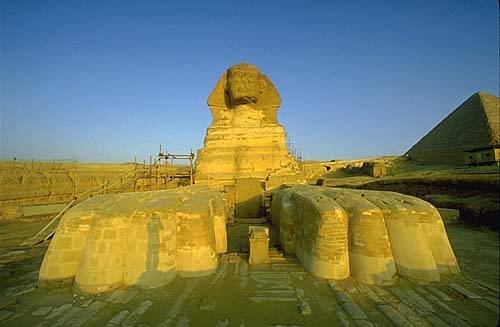
The greatest monumental sculpture in the ancient world, the Sphinx is carved out of a single ridge of stone 240 feet (73 meters) long and 66 feet (20 meters) high. The head, which has a markedly different texture from the body, and shows far less severe erosion, is a naturally occurring outcrop of harder stone. To form the lower body of the Sphinx, enormous blocks of stone were quarried from the base rock (and these blocks were then used in the core masonry of the temples directly in front and to the south of the Sphinx). While a few stubborn Egyptologists still maintain that the Sphinx was constructed in the 4th Dynasty by Chephren (Khafre), an accumulating body of evidence, both archaeological and geological, indicates that the Sphinx is far older than the 4th Dynasty, and was only restored by Chephren during his reign. There are no inscriptions on the Sphinx, or on any of the temples connected to it that, that offer any evidence of construction by Chepren, yet the so-called 'Inventory Stele' (uncovered on the Giza plateau in the nineteenth century) relates how Cheops - Chephren's predecessor - ordered a temple built alongside the Sphinx, meaning of course that the Sphinx was already there, and thus could not have been constructed by Chephren.
A far greater age for the Sphinx has been suggested by R.A. Schwaller de Lubicz, based upon geological considerations. Schwaller de Lubicz observed, and recent geologists (such as Dr. Robert Schoch, Professor of Geology at Boston University) have confirmed, that the extreme erosion on the body of the Sphinx could not be the result of wind and sand, as has been universally assumed, but rather was the result of water. Geologists agree that in the distant past Egypt was subjected to severe flooding. This period coincides with the melting of the ice from the last Ice Age (13,000-10,000 BC). Wind erosion cannot take place when the body of the Sphinx is covered by sand, and it can be proved that the Sphinx has been in this condition for nearly all of the last five thousand years - since the alleged time of its 4th Dynasty construction. Furthermore, if wind-blown sand had indeed caused the deep erosion of the Sphinx, we would expect to find evidence of such erosion on other Egyptian monuments built of similar materials and exposed to the wind for a similar length of time. Yet the fact of the matter is, that even on structures that have had more exposure to the wind-blown sand, there are minimal effects of erosion, the sand having done little more than scour clean the surface of the dressed stones. Quite simply, this means the Sphinx was carved before Egypt was inundated with the waters of the great Ice Age floods, and that those waters caused the unique erosion patterns on the Sphinx.
Additional evidence for the great age of the Sphinx may perhaps be indicated by the astronomical significance of its shape, being that of a lion. Roughly every two thousand years (2160 to be exact), because of the precession of the equinoxes, the sun on the vernal equinox rises against the stellar background of a different constellation. For the past two thousand years that constellation has been Pisces the Fish, symbol of the Christian age. Prior to the age of Pisces it was the age of Aries the Ram, and before that it was the age of Taurus the Bull. It is interesting to note that during the first and second millennia BC, approximately the Age of Aries, ram-oriented iconography was common in dynastic Egypt, while during the Age of Taurus the Bull-cult arose in Minoan Crete. Perhaps the builders of the Sphinx likewise used astrological symbolism in designing their monumental sculpture. The geological findings discussed above indicate that the Sphinx seems to have been sculpted sometime before 10,000 BC. and this period coincides neatly with the Age of Leo the Lion, which lasted from 10,970 to 8810 BC.
Further support for this vast age of the sphinx comes from a surprising sky-ground correlation proven by sophisticated computer programs such as Skyglobe 3.6. These computer programs are able to generate precise pictures of any portion of the celestial vault as seen from any place on earth at any time in the distant past or future. Graham Hancock explains in Heaven's Mirror that, "computer simulations show that in 10,500 BC the constellation of Leo housed the sun on the spring equinox - i.e. an hour before dawn in that epoch Leo would have reclined due east along the horizon in the place where the sun would soon rise. This means that the lion-bodied Sphinx, with its due-east orientation, would have gazed directly on that morning at the one constellation in the sky that might reasonably be regarded as its own celestial counterpart."
All this means that the monumental sculpture of the Sphinx may have existed at a time when (according to prevailing archaeological theory) there were no civilizations on earth and humans had not yet evolved beyond hunter-gatherer lifestyles. This matter is so radical that scholarly reticence in acknowledging it is understandable. If the Sphinx does indeed predate the flooding of Egypt, our notions of the development of civilization must be entirely rewritten and the mystifying question of Plato's Atlantis should be given very serious consideration.
A thorough discussion of the Sphinx and its many riddles is too complex and lengthy a subject to deal with in this book. Readers interested in this matter, as fascinating as the mystery of the Great Pyramid, are encouraged to consult The Traveler's Key to Ancient Egypt, and Serpent in the Sky by John Anthony West, and Fingerprints of the Gods and Heaven's Mirror by Graham Hancock and the The Message of the Sphinx by Robert Bauval and Graham Hancock.